Skip to content
Minnesota voter rights and early voting information card

Minnesota voter rights, mutual aid, and early voting information

Know your rights, make a plan, and help your neighbors get to the polls.

Key 2026 Voting Dates

  1. June 26, 2026Early voting begins (Primary)
  2. August 10, 2026Last day to vote early in person (Primary)
  3. August 11, 2026Primary Election Day
  4. September 18, 2026Early voting begins (General)
  5. November 2, 2026Last day to vote early in person (General)
  6. November 3, 2026Election Day

Minnesota Early Voting Mutual Aid Guide

Voting should not be hard. No one should miss an election because they need a ride, cannot print a form, need language help, are elderly, are disabled, are sick, or do not know where to start.

In Minnesota, you can vote before Election Day by mail or in person. You can also ask for help voting. Your vote is still yours. No one helping you should pressure you, ask to see your ballot, tell you who to vote for, or tell anyone how you voted.

To Voters and Mutual Aid Community Members

You do not have to vote alone. You can vote early. You can vote by mail. You can ask for help. You can get a ride. You can use language support. You can use disability access. You can vote if you are elderly, disabled, sick, busy, working, caring for family, or unsure where to start.

Mutual aid means we help each other overcome the barriers that keep people from voting.

Your vote belongs to you. Help is allowed. Pressure is not.

Key dates

Primary Election

  • June 26, 2026 You can start voting before Election Day by mail or in person.
  • July 21, 2026 Register by this day to save time. You can still register later, including on Election Day, if you bring proof of where you live.
  • August 10, 2026 Last day to vote early in person for the primary.
  • August 11, 2026 Primary Election Day. Ballots must be received by Election Day.

General Election

  • September 18, 2026 You can start voting before Election Day by mail or in person.
  • October 13, 2026 Register by this day to save time. You can still register on Election Day if you bring proof of where you live.
  • November 2, 2026 Last day to vote early in person for the general election.
  • November 3, 2026 Election Day. Ballots must be received by Election Day.

How we can help each other vote

Give people rides

Some people cannot easily get to an early voting site, election office, or polling place. Offer rides to neighbors, elders, disabled people, students, people without cars, and anyone who asks.

Rides should be free, respectful, and no-pressure. Do not ask someone who they are voting for. Do not tell them how to vote. Just help them get there and back safely.

A good script:

“I’m helping people get to vote. I won’t ask who you’re voting for. I can help you find your voting location, make a ride plan, and get there safely.”

Help people make a voting plan

Sit down with someone and help them answer:

  • Am I registered at my current address?
  • Do I want to vote by mail, vote early in person, or vote on Election Day?
  • Where do I vote?
  • Do I need proof of residence?
  • Do I need a ride?
  • Do I need language help?
  • Do I need disability access?
  • Do I need help reading, marking, or returning my ballot?

A plan made early prevents panic later.

Help print forms and voter information

Many people do not have a printer. Mutual aid can help by printing:

  • Absentee ballot applications
  • Large-print absentee ballot applications
  • Voter registration forms
  • Proof-of-residence information
  • “How to Vote” factsheets
  • Language-access materials
  • Local early voting hours and locations

Do not say you are printing absentee ballots. In most cases, voters request an absentee ballot from election officials. What volunteers can safely help print are applications, instructions, and voter information.

Help people request a mail ballot

Any Minnesota voter can apply to vote by mail. Help people find the absentee ballot application, fill it out, and send it to the correct county election office.

Respect privacy. Do not keep someone’s personal information. Do not take photos of their forms. Do not fill out anything they do not understand or agree to.

Help with ballot return

If someone votes by mail, help them return the ballot early. A ballot must be received by Election Day. A postmark is not enough.

A voter can return their own ballot to the election office that sent it. Someone else may also drop off ballots for up to three other voters, but they must show identification with their name and signature.

Do not bring an absentee ballot to a regular polling place on Election Day. Return it to the election office that sent it.

Help elderly and disabled voters

Elderly and disabled voters have the right to vote. People do not lose the right to vote just because they are elderly, disabled, have memory loss, have a guardian, live in a care setting, or need help.

Offer help with:

  • Reading voting instructions
  • Finding accessible voting options
  • Calling the county election office
  • Requesting an accessible absentee ballot
  • Getting a ride
  • Finding curbside voting
  • Returning a ballot
  • Understanding deadlines

If a voter needs help marking a ballot, the helper must follow the voter’s choices. The helper must not influence the vote or share how the person voted.

Help people use agent delivery when they qualify

Some voters may qualify for agent delivery. This means someone they know can pick up and return an absentee ballot for them.

This may apply if the voter lives in a nursing home, assisted living facility, residential treatment center, group home, or shelter; is hospitalized; or has difficulty going to the polling place because of a disability or serious health reason.

Agent delivery has rules. The agent must be at least 18, have a pre-existing relationship with the voter, cannot be a candidate, and cannot serve as agent for more than three voters in an election.

Provide water, snacks, chairs, and weather support

Voting should not be an endurance test. Mutual aid can help by offering:

  • Water
  • Snacks
  • Hand warmers
  • Umbrellas
  • Chairs
  • Masks
  • Phone chargers
  • Rides home
  • Help finding bathrooms
  • Help checking wait times

Do this carefully. Do not campaign while offering support. Do not wear campaign gear. Do not pressure voters. Do not block entrances. Do not linger inside or too close to a polling place. Follow election rules and listen to election workers. There are specific rules for how close you can be to a polling station. There are specific rules for what is considered campaigning. Look up the rules for your area.

Help with language access

Voting instructions are available in Spanish, Hmong, and Somali at polling places for state elections. Some areas may have more translated materials or interpreter help.

Mutual aid can help by:

  • Sharing translated voting materials
  • Helping voters call election offices
  • Helping voters find language-access resources
  • Connecting voters with trusted interpreters
  • Making sure people know they can ask for help

Language help should never become pressure. The voter decides. The helper supports.

What helpers must never do

Helpers should never:

  • Tell someone who to vote for while helping them vote
  • Ask to see a completed ballot
  • Change or mark a ballot against the voter’s wishes
  • Keep someone’s personal information
  • Pressure someone in a car, at home, or near a polling place
  • Campaign inside or near a polling place
  • Block access to a voting location
  • Return more ballots than allowed
  • Give legal advice they are not qualified to give

Register to vote online


If Someone Challenges Your Right to Vote

1. Say clearly: “I am eligible to vote, and I want to vote.” If someone is stopped, questioned, challenged, or arrested before casting a ballot, the voter should say this to an election judge, poll worker, attorney, or support person. The goal is to preserve the voting issue, not debate police.

2. Ask for the head election judge immediately. At a Minnesota polling place, election judges are the people who can help voters navigate problems. Minnesota says voters have the right to ask election judges for help, bring someone to help them vote, use accessible voting equipment, or vote curbside if they cannot easily enter the polling place. (Minnesota Secretary of State)

3. Stay in line if polls close. Minnesota voters have the right to vote if they are in line before 8 p.m. This should be in bold on any voter-facing guide. (Minnesota Secretary of State)

4. In Minnesota, active registered voters usually do not need ID. Minnesota’s Secretary of State says voters whose registration is current and active do not need to bring identification. ID or proof of residence is needed if the voter must register, update registration, or has not voted in four years or more. (Minnesota Secretary of State)

5. Same-day registration is available in Minnesota. If a voter is not registered or needs to update their registration, Minnesota allows Election Day registration with required proof of residence. (Minnesota Secretary of State)

6. Add a challenge script. Minnesota allows voter challenges only when the challenger has personal knowledge that a specific voter is not eligible. Suspicion is not enough. Challengers cannot speak directly to the voter, cannot be disruptive, cannot take photos, cannot inspect voter lists, and cannot attempt to influence voting. (Minnesota Secretary of State)

Suggested script:

“I am eligible to vote. Please get the head election judge. I want the challenge handled under Minnesota law.”

7. Do not tell Minnesota voters to rely on a provisional ballot. National voting-rights guides often say to ask for a provisional ballot, but Minnesota is different. Minnesota has same-day registration and does not generally use provisional ballots the way many other states do; a 2026 bill to add provisional ballots for certain same-day registrants was reported as rejected. (Minnesota House of Representatives) For Minnesota, the safer instruction is: ask for the head election judge, call the county election office, and call Election Protection.

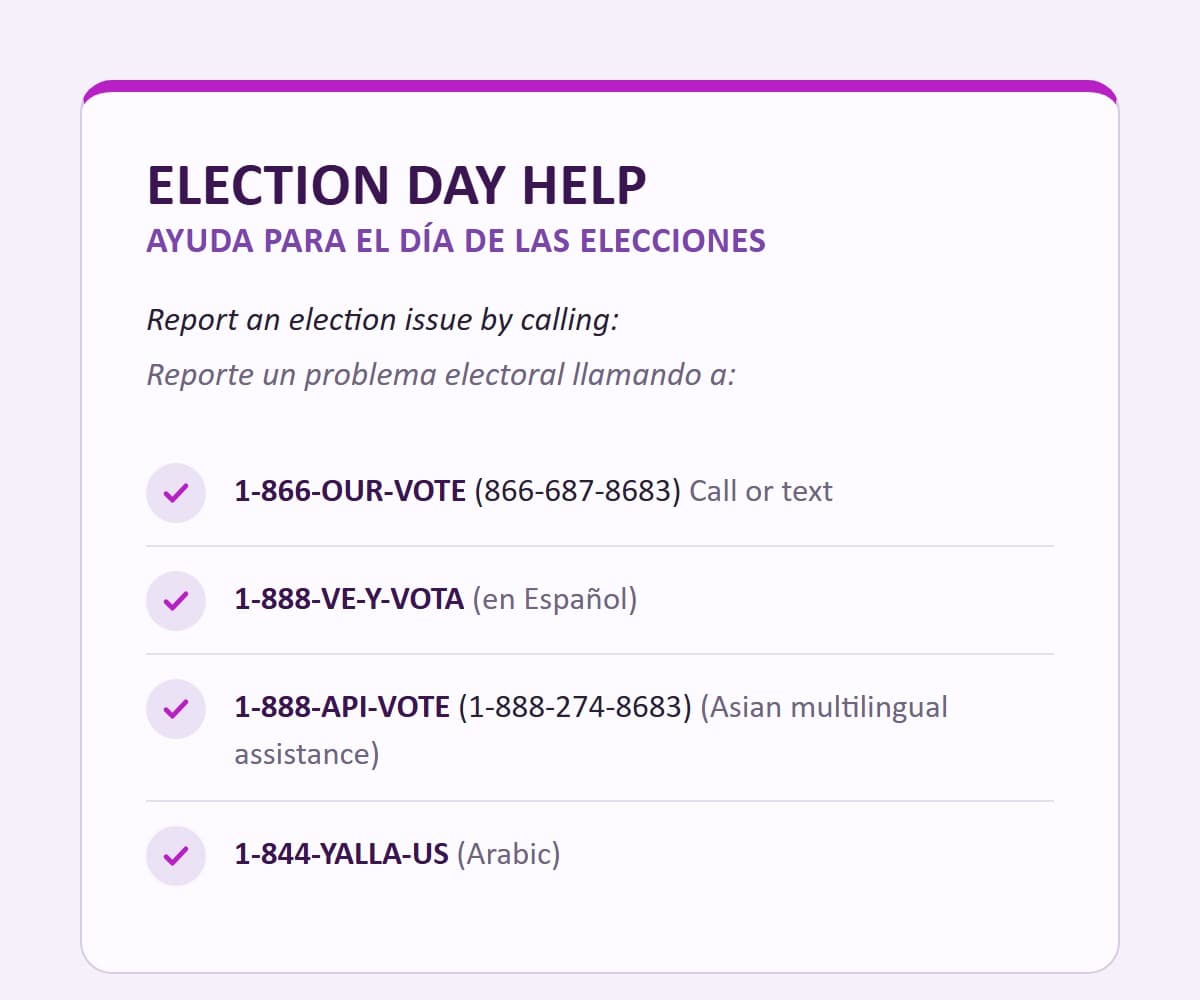
**8. Hotline numbers ** Use these as “call now” numbers:

9. Voter-intimidation language. Federal law prohibits intimidation, threats, or coercion throughout the voting process, including registration, casting a ballot, and vote counting. DOJ says this can include harassment, surveillance, discriminatory challenges, doxing, and false information about voting time, place, or manner. (Department of Justice)

Suggested script:

“I believe this may be voter intimidation. I want the head election judge, and I want this documented.”

10. Mutual aid near polling places. People giving rides, water, childcare help, language help, or accessibility support should avoid anything that looks like campaigning or interference. Minnesota does not allow campaigning inside the polling place or within 100 feet of the building; on public property, campaigning is barred anywhere on the property. Political clothing or materials related to candidates, parties, or ballot questions on the ballot must be covered or removed inside the polling place. (Minnesota Secretary of State)

11. Documentation rules. Witnesses should document arrests or intimidation when safe, but Minnesota discourages photos or videos inside polling places because of voter privacy and disruption risks; showing a marked ballot to others is prohibited. (Minnesota Secretary of State) Safer instruction: document from outside, write down badge numbers, agency names, times, locations, vehicle plates, and witness names.

12. Assistance and accessibility rights. Minnesota voters may bring someone to help them vote, except an agent of their employer or union. Helpers may assist through the voting process, including in the booth, but cannot influence the vote or reveal how the voter voted. (Minnesota Secretary of State)

13. Curbside voting. If someone cannot easily leave their vehicle, Minnesota allows curbside voting. Two election judges from different major parties bring the ballot to the voter’s vehicle and return it to the ballot box. (Minnesota Secretary of State)

14. "Replacement ballot” instructions. Minnesota voters have the right to a replacement ballot if they make a mistake before casting it. (Minnesota Secretary of State)

15. "Time off work” protection. Minnesota voters have the right to take paid time off work to vote without losing pay, personal leave, or vacation time. Employers cannot directly or indirectly interfere with that right, including by controlling what time the employee chooses to vote. (Minnesota Secretary of State)

16. Criminal-record eligibility language. In Minnesota, a criminal record does not affect the right to vote unless the person is currently incarcerated for a felony conviction. People can vote if they are in jail but not serving a felony sentence, charged but not convicted, on parole, on probation, on work release, or convicted of a felony but not incarcerated. (Minnesota Secretary of State)

17. Citizenship warning. Only U.S. citizens may vote in Minnesota elections. Green card holders are not eligible. This is especially important if the guide is paired with NILC immigration-rights material. (Minnesota Secretary of State)

If something goes wrong while you are trying to vote:

  • Act calm.
  • Do not argue with police, ICE, challengers, or strangers.
  • Say: “I am eligible to vote, and I want to vote.”
  • Ask for the head election judge. If you are questioned by law enforcement,
  • Say: “I want to remain silent, and I want a lawyer.”
  • Do not sign any immigration papers or arrest papers you do not understand.
  • If someone challenges you, say: “Please handle this under Minnesota law. I want to vote.”
  • Call or text 866-OUR-VOTE for help.

If you are in line before 8 p.m., stay in line. If you need help because of disability, language, reading, writing, or access needs, ask an election judge or bring someone you trust who is not your employer or union representative.

Help your neighbors vote. Chip in today.